Backcountry first aid · CA

woodticks.ca

Print · Fold · Save
Keep with first aid kit

·   Identification key   ·

What kind of tick
was that?

Four species do nearly all the biting in Canada. Two of them — the blacklegged tick and the lone star — carry significant disease risk. The other two bite often but transmit Lyme rarely or never. Get the species right and the next step gets a lot clearer.

Quick decision

Where was it found and how big was it?

  • Tiny (poppy-seed size), grey-brown, found in southern Ontario, Quebec, the Maritimes or southern Manitoba? Most likely a blacklegged tick nymph. This is the riskiest combination — small, often missed, and the primary Lyme vector.
  • Bigger (sesame to apple-seed), reddish brown with patterned grey-white markings on the back? Likely an American dog tick(also called a wood tick) — most common species, but doesn’t typically transmit Lyme.
  • Round body with a single white dot in the centre? That’s a female lone star tick. Found in southwestern Ontario, occasionally further north. Aggressive biter, linked to alpha-gal syndrome.
  • Found west of the Rockies? Likely a Rocky Mountain wood tick; similar to the dog tick but smaller.

Canadian species

Four ticks that bite humans in Canada.

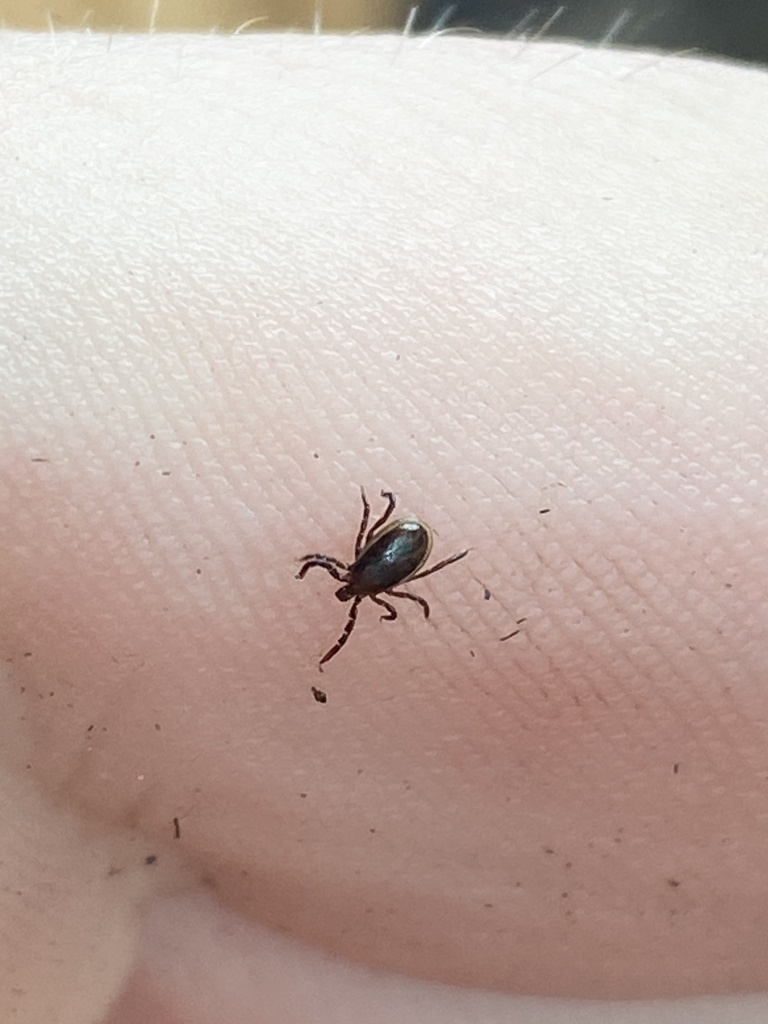
Blacklegged tick (Ixodes scapularis) — close-up on skin showing the long mouthparts characteristic of Ixodes.

Adult on skin. Note the long, narrow mouthparts — diagnostic for Ixodes.

Photo: Hayes Valentine · iNaturalist · CC BY 4.0

Schematic

Primary Lyme vector

Blacklegged tick · Deer tick

Ixodes scapularis

The only tick in eastern Canada that reliably transmits Lyme. Range is expanding north every year.

Identification

  • Small — adult about 3 mm, nymph the size of a poppy seed.
  • Long, narrow mouthparts (visibly longer than dog ticks).
  • Female: dark scutum behind the head, orange-red abdomen. Male: solid dark brown all over.
  • No white markings, no festoons (the rectangular rear-edge notches).

Range

Established in southern Ontario, southern Quebec, the Maritimes, southern Manitoba, and parts of southeastern Manitoba. Expanding north and west. British Columbia has a related species (I. pacificus) along the south coast.

Diseases

Lyme disease, anaplasmosis, babesiosis, Powassan virus, and (rarely) Borrelia miyamotoi.

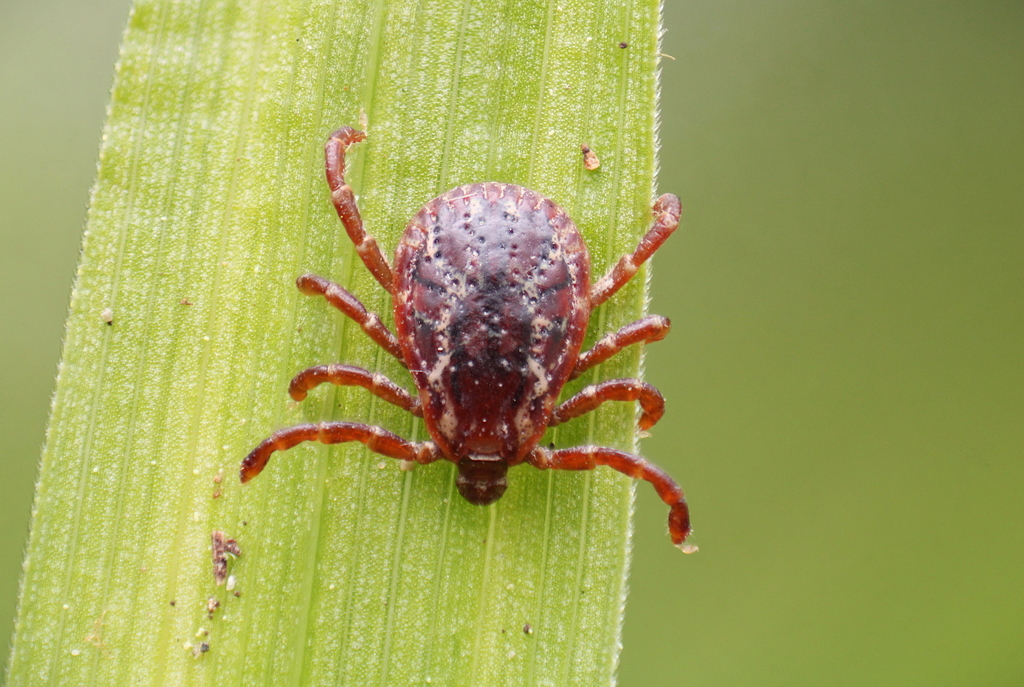
American dog tick (Dermacentor variabilis) — dorsal view showing the marbled grey-white scutum pattern.

Adult female on a grass blade. The marbled white scutum is the dog tick's signature.

Photo: Matthew Lindsey · iNaturalist · CC BY 4.0

Schematic

Most common in Canada

American dog tick · Wood tick

Dermacentor variabilis

The big, patterned tick that most Canadians have actually pulled off a dog. Bites people too, but doesn't transmit Lyme.

Identification

  • Larger — adult about 5 mm unfed, can swell to nearly the size of a grape engorged.
  • Patterned grey-white marbling on the scutum (the plate behind the head). Body is reddish brown underneath.
  • Short mouthparts (noticeably stubbier than blacklegged).
  • Festoons: rectangular notches around the rear edge of the body.

Range

Widespread across southern Canada from BC east to Nova Scotia, though most common in the central provinces and southern Ontario.

Diseases

Rocky Mountain spotted fever (rare in Canada), tularemia (very rare), tick paralysis. Does not transmit Lyme.

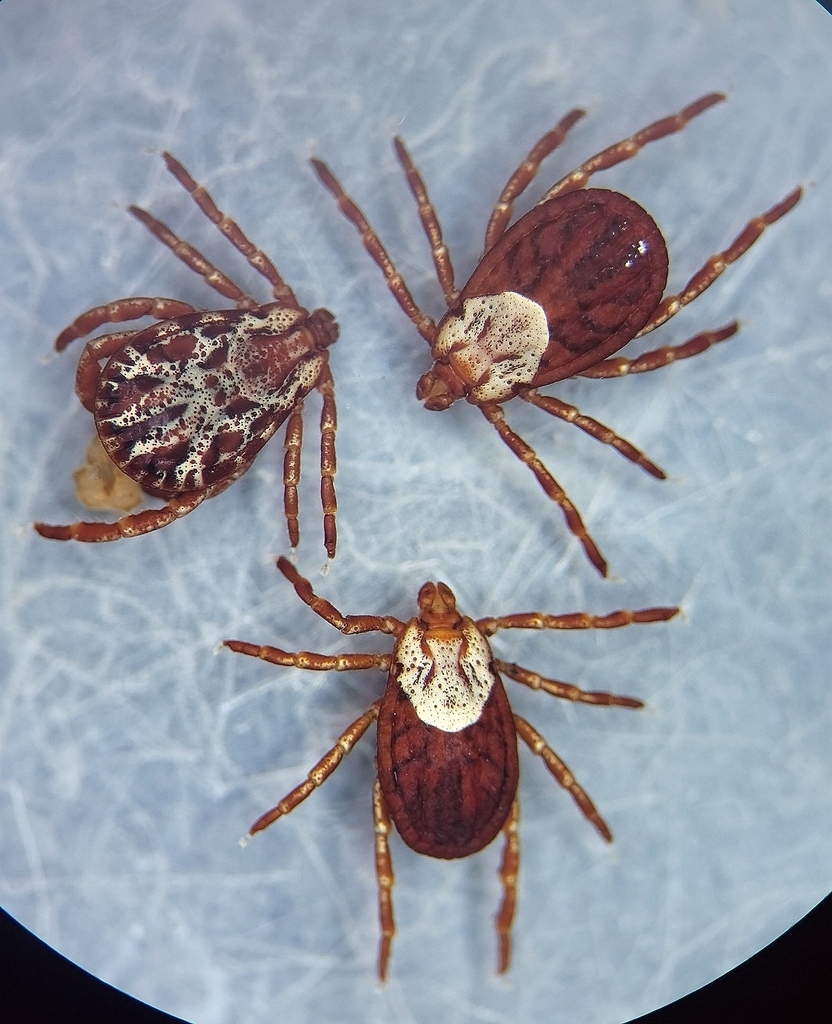
Rocky Mountain wood tick (Dermacentor andersoni) — three specimens showing the marbled scutum patterning.

Three specimens — note the marbled scutum, slightly more uniform than the dog tick.

Photo: Toby · iNaturalist · CC BY 4.0

Schematic

Western Canada

Rocky Mountain wood tick

Dermacentor andersoni

Sister species to the American dog tick — looks similar, lives further west.

Identification

  • Similar to American dog tick but slightly smaller and more uniformly patterned.
  • Mottled brown and silver scutum.
  • Short mouthparts. Festoons on the rear edge.

Range

Interior British Columbia, southern Alberta, and southwestern Saskatchewan — primarily in foothill and grassland habitats.

Diseases

Rocky Mountain spotted fever, Colorado tick fever, and tick paralysis. Does not transmit Lyme.

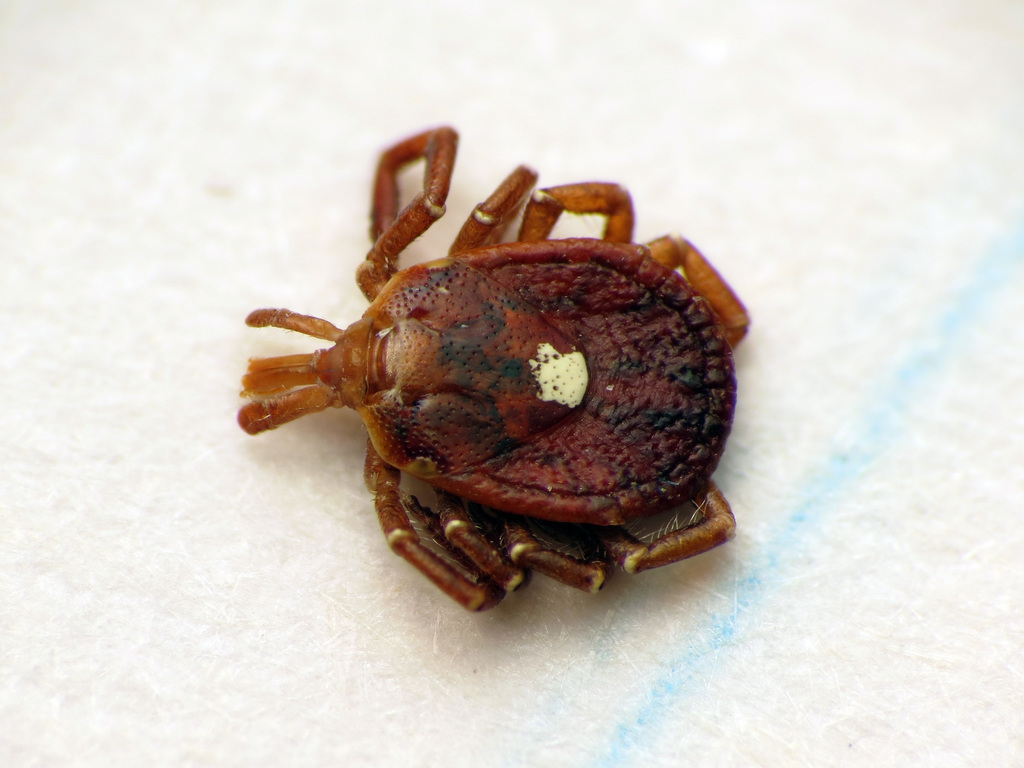
Lone star tick (Amblyomma americanum) — female with the diagnostic single white dot on the back.

Adult female. The single white dot in the centre of the back is diagnostic.

Photo: Katja Schulz · iNaturalist · CC BY 4.0

Schematic

Emerging in Ontario

Lone star tick

Amblyomma americanum

Aggressive biter, linked to alpha-gal syndrome (red meat allergy). Established in the U.S. southeast; increasingly found in southern Ontario.

Identification

  • Rounded, reddish-brown body — about 5 mm unfed.
  • Adult female: single bright white dot in the centre of the back. This is diagnostic.
  • Long mouthparts (visibly long, like the blacklegged).
  • Aggressively hunts hosts — will chase movement, unlike the ambush-style of other species.

Range

Established populations recently confirmed in southwestern Ontario. Sporadic individuals found further north — likely arriving on migratory birds.

Diseases

Ehrlichiosis, southern tick-associated rash illness (STARI), and alpha-gal syndrome (delayed red meat allergy). Does not transmit Lyme.

Size matters

Life stages — the dangerous one is the smallest.

Most Canadians who get Lyme don’t remember being bitten. The reason is the nymph— a blacklegged tick’s second life stage, about the size of a poppy seed and easy to miss in a tick check. By contrast, the engorged adult that ends up on the dog after a hike is hard to overlook.

Larva

≈ 0.5 mm

Smaller than a poppy seed

Six legs. Hatches from eggs in summer. Bites mice and birds, rarely people.

Nymph

≈ 1.5 mm

Poppy seed

Eight legs. Active May–July in eastern Canada. The stage most responsible for human Lyme cases — easy to miss.

Adult

≈ 3 mm unfed, ≈ 10 mm engorged

Sesame to apple seed

Active spring and fall. Most often spotted on dogs. Female is the biter; male feeds little.

Engorged or not

A swollen tick tells you how long it was attached.

Unengorged

Found and removed quickly.

Flat, hard, the tick’s body smaller than its head looks like it should fit. If it’s still flat the risk of Lyme transmission is low — the tick wasn’t attached long enough to feed. Still save it, still watch for symptoms, but you’re likely in the clear.

Engorged

Attached long enough to feed.

Body swollen and grey-green, far larger than the head. An engorged blacklegged tick has likely been attached 24+ hoursand may have transmitted Lyme. This is the case where the Ontario pharmacist’s preventive doxycycline window matters most — see the removal page.

Where they live

Range, by province.

Tick ranges shift faster than range maps are updated. As a rule of thumb, ranges are expanding north and west each year. If your area wasn’t a Lyme zone a decade ago, that doesn’t mean it isn’t now. The Public Health Agency of Canada publishes the current Lyme risk areas.

Open the interactive map

Ontario

Blacklegged

Established across most of southern and eastern Ontario.

Other species

American dog tick widespread. Lone star tick emerging in the southwest.

Quebec

Blacklegged

Established in the southwest, particularly Montérégie and Estrie.

Other species

American dog tick common throughout.

New Brunswick

Blacklegged

Established along the southern coast and Fundy area.

Other species

American dog tick widespread.

Nova Scotia

Blacklegged

Province-wide; among the highest blacklegged tick densities in Canada.

Other species

American dog tick widespread.

PEI

Blacklegged

Established. Smaller population than NB/NS but present.

Other species

American dog tick common.

Manitoba

Blacklegged

Established in the southeast (Whiteshell area, parts of the south).

Other species

American dog tick widespread.

Saskatchewan / Alberta

Blacklegged

Sporadic — mostly hitchhikers on migrating birds. Few established populations yet.

Other species

Rocky Mountain wood tick in foothills; American dog tick in the south and east.

British Columbia

Blacklegged

The western blacklegged (Ixodes pacificus) is established along the south coast and lower mainland.

Other species

Rocky Mountain wood tick interior. American dog tick south.

Newfoundland & Labrador

Blacklegged

Sporadic. No confirmed established population on the island as of 2026.

Other species

Most tick reports are hitchhikers on dogs returning from elsewhere.

Last reviewed

General information only — not medical advice. In an emergency, call 911. Read the full disclaimer.

Tick alerts · CA

Seasonal alerts for your inbox.

Eight emails a year. Spring and fall activity peaks, news on where ticks are showing up across Canada, and what’s biting in your area. No spam, no sales.

Seasonal alerts only. About eight emails a year. Unsubscribe in one click.